

Falling short
What three parties tell us about the right

At the end of July, I will be driving to Ukraine. I’ll be part of a convoy delivering vehicles for medical evacuations at the front line. I’ll be driving across Europe, from the UK to Lviv.
I’m currently fundraising for the trip - aiming to raise £7,000. This money will purchase the vehicle, fund modifications, and the costs of getting it there. Any surplus will fund other equipment, like drone detectors and medical equipment.
Any support is hugely appreciated and will make a difference. You can donate here.
Thank you!
The next few weeks will be dominated by the left’s response to the Makerfield by-election. A victorious Andy Burnham is set to march south and challenge for the Labour leadership. A contest will ensue, and there is every chance we will have a new Prime Minister by the summer recess. It will then be seen whether Burnham reinvigorates the Labour Party or succumbs to the same unpopularity and failure that have dogged other recent Prime Ministers. But there are also many implications for the right.
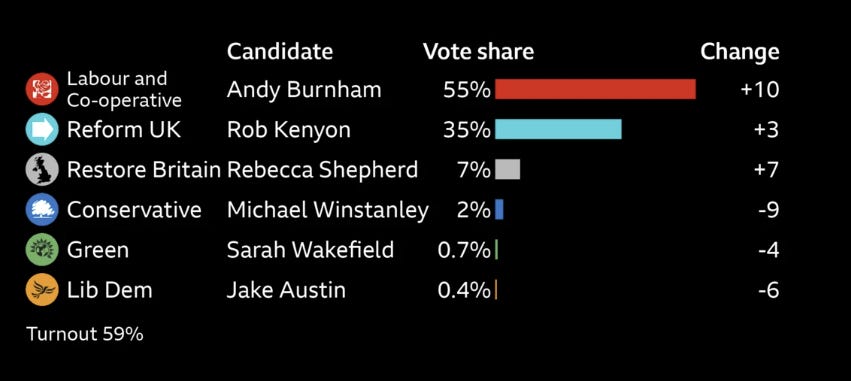
Makerfield was the second major by-election in a row where Reform failed to win. Once again, they were outperformed by an efficient electoral alliance. While this contest was an unusual one, with a popular local politician effectively running against the leader of his own party, it conformed to the same pattern seen in G&D, and before that, the Caerphilly Senedd election. The “stop Reform” vote stacked up behind the best-placed candidate. Andy Burnham outperformed Labour’s woeful polling and managed to win.
The result in Makerfield is, however, more important than that in Gorton and Denton. G&D is an urban seat with demographics that are largely unfavourable to Reform. It was only in-play because Labour were doing so badly and there was a risk of a three-way split. Makerfield is different. It is the sort of seat that should be a straight Lab/Ref fight, and one which Reform should win if they are on course to do well at the next election. Based on percentages alone, it should be in their top 30 target seats.
More structurally, the primary theory of Reform victory has to run through seats like Makerfield. The working assumption has been that Farage’s party can complete the post-Brexit realignment of the right, and claim seats that the Conservatives never could, at the expense of some of the more liberal and affluent places that voted Tory. Makerfield suggests that this isn’t happening to the extent it needs to. In this result, Reform hoovered up almost all the Conservative votes in the seat. That is an achievement for them, and the implications should not be diminished. But it is not enough to win the seat.
This points to the broader problem with Reform’s polling. They are not doing well enough, in ordinary circumstances, to win. Their polling performance, hovering in the mid-to-upper twenties, is impressive for an insurgent party and puts them at the top of the fragmented political landscape. Still, it is well below what a party needs to win if the left block restabilises. It is barely above what the Conservatives achieved in the 2024 General Election. Again, it indicates a failure in their overall mission.
Reform has not yet fully replaced the Conservative Party. Farage has, for sure, taken a lot of their voters. The Conservatives are polling at a historic low, even below their 2024 general election result. They are, however, still holding on as a stubborn third party. The Aberdeen result, also overnight, nods towards this. In seats with slightly unusual demographic or political trends, they can hold on and even win. It is the same pattern as the local elections. The party is holding on in places that are a bit richer or a bit more politically liberal, or in Scotland, where they can be the best placed Unionist choice.
Reform, leading in the polls, has not been enough to draw people in. It is not great for the Conservatives that they are only polling 20% or so. But, significantly, this amount is holding up. It suggests the existence of an anti-Farage right that could become an important tactical voting bloc. In straight Ref/Con fights, they will vote Conservative. Elsewhere, they might be tempted to “unite the right”. But they might also be drawn tactically to the best-placed anti-Farage candidate. Some on-the-ground evidence suggests this was happening in Makerfield, with Tories reluctantly backing Burnham against the Reform candidate. En masse, this becomes a real problem for Reform. To form a government, they either have to claim all the seats the Tories could aim for at their peak or win most and add to them with Labour seats. These results suggest that they can’t comfortably do either.
The outcomes of the two by-elections also suggest they are bad at knowing what it requires. In both seats, they have selected exceptionally poor candidates for reconciling reluctant right-wingers with their base. Both were combative characters with a history of provocative comments and oddly professed views on women. That is not a good combo for reassuring Tory voters. It speaks once again of their biggest challenge – bringing together the voters who like Reform because “they are not your grandma’s Tory Party” and, well, your grandma. This is also why the association with the Henry Novak and Southport riots is bad for Reform. Lots of Tory voters don’t like the sight of tanked-up thugs burning bins, and don’t want to be on their side.
The rise of Restore has further complicated this. The party appeared in Makerfield as a genuine electoral risk for Farage. Though they only claimed 7% of the vote and didn’t make a difference this time, they represent a real vulnerability for Reform. Lowe appears to be well-funded and able to put volunteers into the field. Strategically, they are going for Reform’s base – the most radical, the most hyper-online, the first movers of the far right - the sort of people who were backing Reform even through their 2021 slump. Makerfield was probably a good target for them, with its history as a BNP base of support. But if nationally they are at maybe 5%, that still represents about a fifth of the Reform vote - a fifth that they will need to win back to compete seriously, especially if Labour recover.
The challenge here is that this 5% of voters are difficult to reconcile with winning over the Farage-reluctant. They want more aggression, more indulging of white and male grievances. Greater radicalism, probably a greater embrace of conspiracy-adjacent thinking. That’s hard to do while convincing the remaining Conservative voters that you are a safe pair of hands, and that you are not going to scare the horses. One Reform MP highlighted the dilemma on the campaign trail – “we were either too racist, or not racist enough”. Farage is now at risk of getting torn apart by the same problem he foisted on the Tories: by trying to keep both sides of your coalition together, you end up losing both.
Fundamentally, the centre right matters in British politics. It is hard to win anything without appealing to them or at least assuring them you are not a threat. Now, very few are trying to. They are residually Conservative but will move accordingly when tactical pressures prevail. Farage hasn’t picked up enough to be the true champion of the right, and that is a problem for him. It means Reform can lose straight fights against the Conservatives and help the progressive alliance shut them out when it is Ref vs the rest. This effectively blocks both routes to total victory for him. He isn’t properly replacing the Conservative Party, nor is he creating a super force that takes a lot of its support and combines it with a new appeal in the Labour heartlands.
Makerfield has shown the knottiness of the problem for the right. The centre-right voter exists, in decent numbers, and with electoral significance. No one is properly serving it, and so the broader right is stretched inefficiently. With the schism of two, now three, parties on the right, the bottle is broken, and it is hard to put back together. The radicals make all the noise, but the respectable right carries real electoral power. Until someone works out how to speak to both, or is honest enough to choose between them, the right will keep producing results like this one: dramatic, loud, and not quite enough.
Keep reading with a 7-day free trial
Subscribe to Joxley Writes to keep reading this post and get 7 days of free access to the full post archives.